

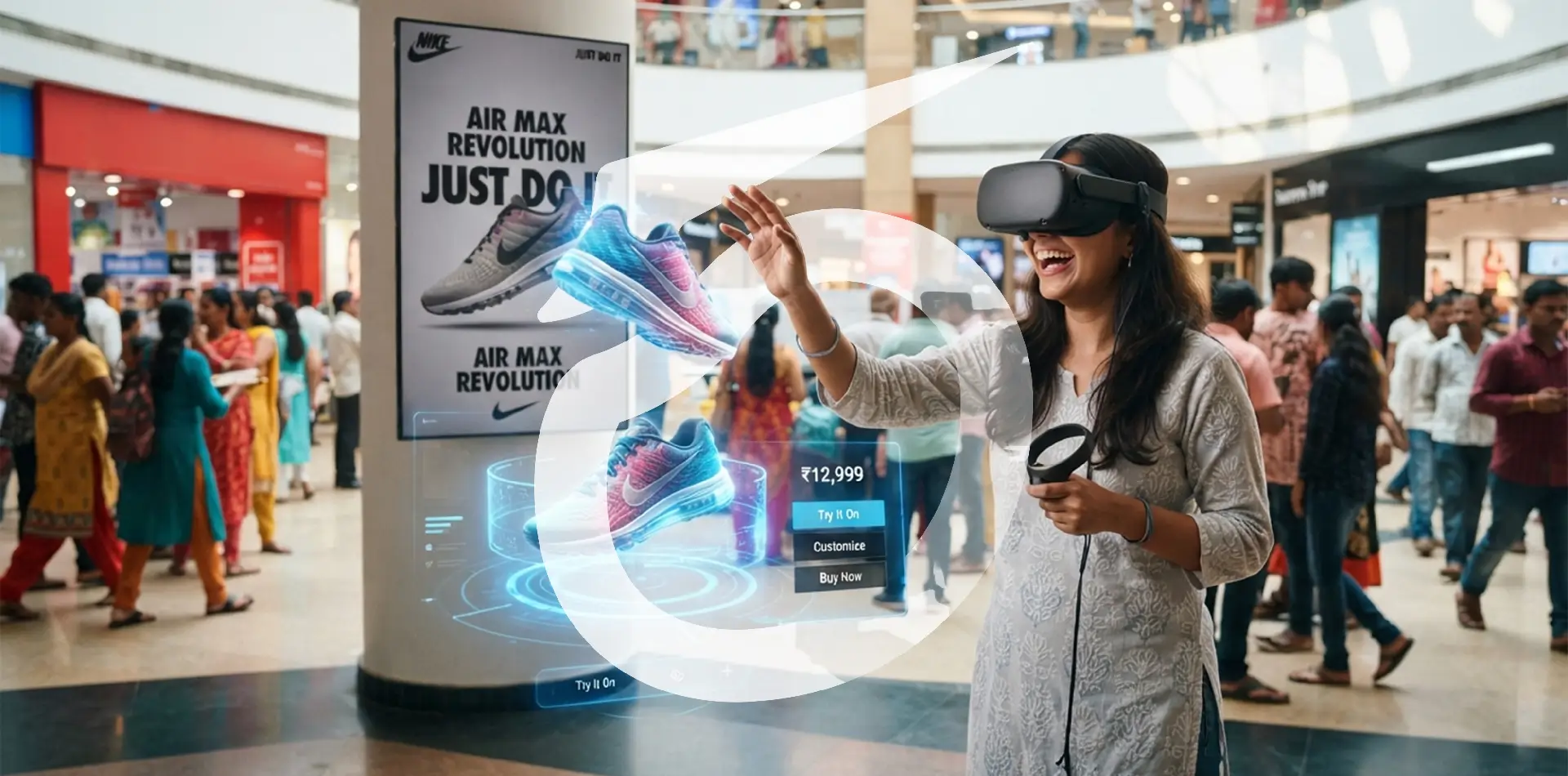
As digital marketing evolves past flat screens and static images, brands are turning to immersive technologies to reshape how consumers interact with products. Augmented Reality (AR) overlays digital elements like 3D objects, filters or data onto your real-world surroundings using a smartphone camera or smart glasses. Virtual Reality (VR), on the other hand, completely replaces your physical surroundings with a fully simulated digital environment, typically experienced through a specialised headset. While AR enhances the world you are already looking at, VR transports you somewhere else entirely.
Immersive advertising uses AR and VR to let people interact with a brand’s story instead of just watching it. It can mean trying on a product virtually, placing furniture inside your room through your phone camera, exploring a property through a virtual walkthrough or entering a brand-created digital environment.
For years, brands believed that a great TVC, a cinematic social video or a high-performing reel was enough to capture attention. But attention has changed. Today’s audience does not only want to see a product; they want to test it, explore it and feel confident before making a decision. That is where immersive advertising is becoming important.
It is not yet a format every small business needs immediately. AR and VR still require planning, budget, technology and the right use case. But for retail, beauty, real estate, automotive, premium lifestyle and high-consideration categories, immersive brand storytelling is no longer just a futuristic idea. It is slowly becoming a practical way to reduce hesitation and build stronger consumer engagement.
Immersive advertising is a form of interactive advertising where people participate in a brand experience instead of passively consuming it. It usually includes augmented reality advertising, virtual reality marketing, 360-degree video, product visualisation, digital showrooms, virtual try-ons or interactive brand spaces.
AR or Augmented Reality adds digital elements to the real world. For example, you can use your phone camera to see how a chair may look in your living room or how a lipstick shade may look on your face. VR or Virtual Reality creates a fully digital environment where the user can explore a space or experience through a headset or screen.
The reason immersive brand experiences matter is simple: interaction builds stronger memory. When a person touches, moves, previews or explores something, the brand becomes more than a message. It becomes an experience.
Deloitte has also noted that augmented shopping can help customers feel more confident in product selection by giving them richer information, interactivity, personalisation and a stronger emotional connection.
But the caveat is important. AR and VR are not magic shortcuts. They need specialised software, 3D assets, technical testing, good UX and higher production quality. For many Indian small and mid-sized businesses, the starting point should not be a full VR campaign. It should be one small, useful immersive feature that solves a real customer hesitation.
AR marketing campaigns are powerful because they bring the product closer to the consumer before the purchase happens. Instead of saying “imagine this sofa in your home,” AR lets the buyer actually see it in their room. Instead of saying “this shade will suit you,” AR lets the person try it virtually.
This changes brand storytelling from claim-based communication to experience-based communication.
Amazon’s “View in Your Room” feature is a good example. It allows shoppers to preview selected products in their own space before buying, helping them understand size, look and fit more clearly. IKEA Kreativ follows a similar direction by allowing users to scan or use a room and bring IKEA products into the space in 3D.
This is where AR becomes more than a “wow” feature. It reduces doubt. It answers questions visually. Will this fit? Will this colour match? Will this product look good in my space? That clarity can influence decision-making because the customer is not only watching the product story; they are placing themselves inside it.
For beauty brands, AR try-on tools have become especially relevant. L’Oréal Paris describes its Virtual Makeup Try On tool as an immersive makeup simulator using augmented reality technology, allowing users to test products virtually. ModiFace, acquired by L’Oréal, also enables AR-based makeup previews on live video or images.
For brands, the lesson is clear: AR works best when it helps the buyer make a more confident decision.
VR brand experiences are more immersive but they are also more expensive and complex. That is why VR currently makes the most sense for high-consideration categories such as real estate, automotive, premium interiors, hospitality, education, industrial products and B2B demonstrations.
In real estate, VR can help a buyer explore a sample flat, a township or an under-construction project remotely. In automotive, virtual showrooms can allow people to see a vehicle, customise features and understand the product before visiting a dealership. In B2B, VR can simplify complex product demonstrations that are otherwise difficult to explain through brochures or static presentations.
The strength of VR is depth. It gives the user time inside the brand’s world. It is not just about showing a product; it is about creating a controlled environment where the brand can guide attention, emotion and information.
But VR should be used selectively. For everyday low-cost products, a heavy VR experience may not justify the investment. For a premium property, a luxury automobile, a high-value machine or an experience-led brand, it can become a serious storytelling tool.
Global pioneers show that the most successful immersive formats prioritize utility over novelty:
Home & Space Visualisation: Amazon (“View in Your Room”) and IKEA Kreativ remove pre-purchase uncertainty by allowing users to accurately place and scan 3D furniture into their physical living spaces.
Virtual Try-Ons: Beauty giants like L’Oréal (via ModiFace) use real-time video simulation to let users experiment with makeup shades instantly, lowering discovery friction.
Practical Problem Solving: Early iterations of Nike Fit combined AR with machine learning to scan feet via smartphones, solving a direct structural friction point getting the right shoe size.
Solve one real hesitation, not ten
The best immersive campaigns do not try to do everything. They solve one clear problem: fit, size, colour, space, product understanding or experience preview.
Go browser-first before app-first
Asking users to download an app adds friction. WebAR or browser-based previews are often easier for users to access, especially for first-time engagement.
Design for mid-range phones
In India, not every user has a flagship device. Heavy 3D assets, slow loading and poor mobile optimisation can kill the experience before it begins.
Always include a fallback
Not every user will use AR or VR. A standard video, image gallery or 360-degree view should support the immersive layer.
Test before scaling
Start with a small pilot. Measure engagement, drop-offs, enquiries, conversions and customer feedback. Scale only when the experience proves useful.
The future of immersive marketing will not be about every brand creating a VR world. It will be about useful interaction. AR previews, virtual try-ons, 3D product views, AI-generated product variations and personalised immersive journeys will become more common where they remove friction.
The next phase will likely bring AI and immersive advertising together. A buyer may see different room layouts instantly. A customer may receive personalised product previews. A real estate prospect may explore a property based on their family size, budget and lifestyle preference.
Still, the honest view is this: immersive advertising is not yet a mass requirement for every brand. It is a growing opportunity for brands that have a clear use case and a real customer hesitation to solve.
As AR and VR continue to mature and capture consumer interest, Optimist is actively preparing to help brands navigate this next frontier of digital marketing. While we continue to build powerful, high-performance web and content experiences today, we are keeping a close eye on these emerging technologies to guide our clients in the future. When you are ready to explore immersive storytelling, we will be there to help you identify the right friction points to solve, map out accessible WebAR pilots and design interactive digital experiences that drive real consumer confidence.
Immersive advertising is not about replacing films, reels, websites or social media content. It is about adding a layer of interaction where the customer needs more confidence.
For some brands, that may mean an AR try-on. For others, it may mean a virtual showroom, a 360-degree walkthrough or a product visualisation tool. The goal is not to look futuristic. The goal is to reduce buyer hesitation and make the brand experience more memorable.
You do not need a VR headset to start. You need one real customer hesitation worth solving first.
Unbranded visual search happens when people search by product type, look, category or style instead of a company name. It matters because brands can be discovered by people who do not already know them.
No. The logo remains essential. It confirms the brand’s identity. The point is that the logo needs a strong visual system around it that’s colour, shape, packaging and photography. So, the brand can be recognised even before the name is searched.
No. It is relevant to packaging, food, jewellery, furniture, home goods, real estate, industrial products and even B2B brands. Any category where people compare products visually can benefit from stronger visual identity.
Regular SEO focuses heavily on keywords, content, links and technical structure. Visual search optimisation also considers image quality, consistency, product photography, packaging, alt text, file names and recognisable visual cues.